
Cricket’s two wealthiest bilateral rivals have spoken together.
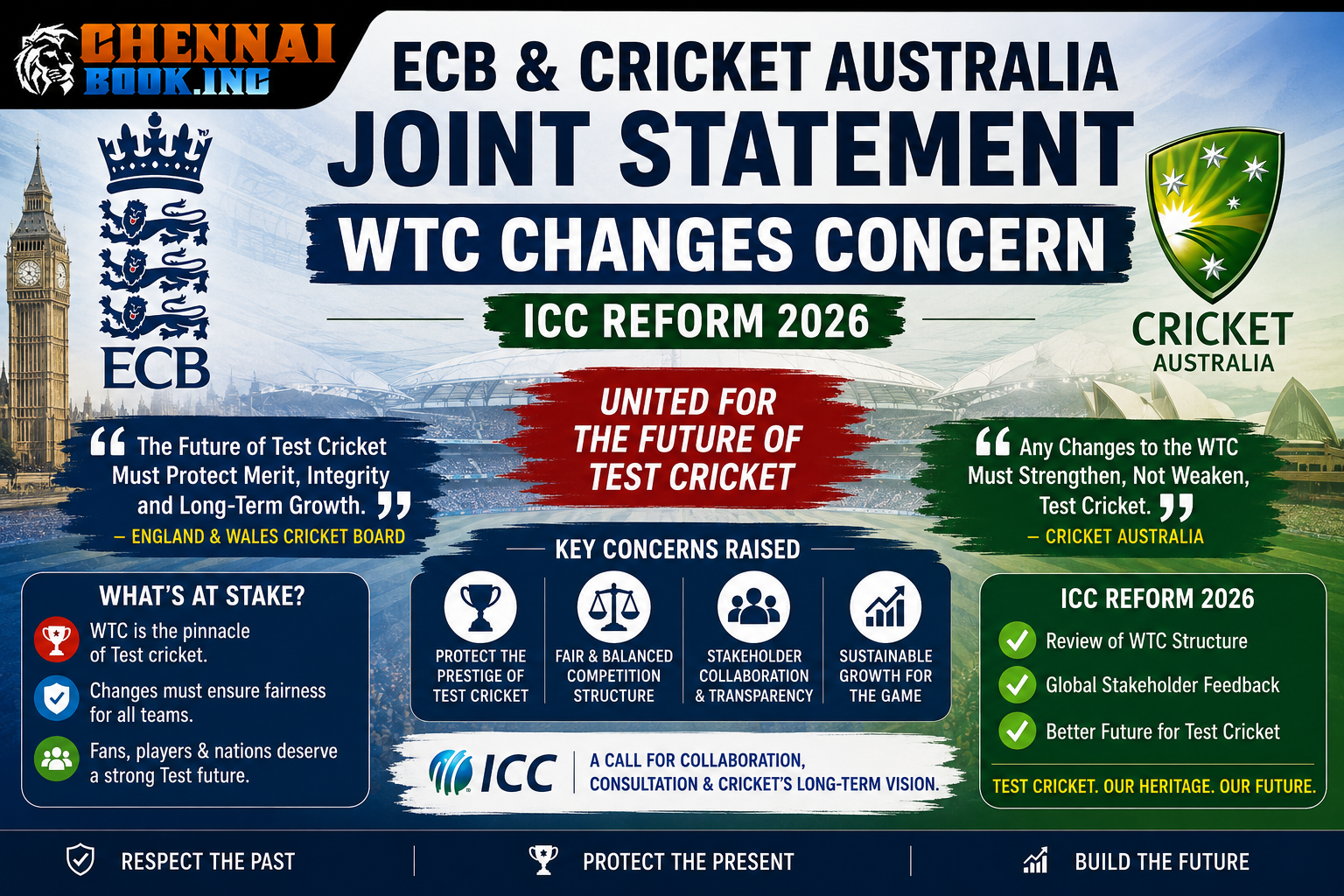
The ECB Cricket Australia WTC concerns 2026 joint statement — released on August 10 — is the most significant governance challenge the ICC has faced since the Big Three controversy of 2014. In a joint statement, England and Wales Cricket Board and Cricket Australia expressed “significant concerns about both the impact of these changes and the process through which they have been introduced.” Two boards. One statement. The specific combination of ECB and CA speaking together about the ICC reform debate sends a message that the ICC cannot dismiss the way it might dismiss a single board’s complaint — these are the two nations whose bilateral schedule generates more revenue than any other Test series outside India’s home games, and their joint objection to the process of ICC’s WTC reform carries the specific weight that only financial significance can produce. The this governance controversy statement arrives in the context of a sweeping ICC reform programme announced at the Edinburgh AGM in July 2026 — changes to the ODI World Cup format, a proposed two-tier WTC structure, a new global club T20 league and the McKinsey strategic review that has been driving these discussions. Most of those changes are now being walked back or modified. The two-tier WTC — the specific proposal that most alarmed England and Australia — has already been scrapped after failing to gain widespread support. What the this joint statement story statement is really about is not the specific proposals that were rejected. It is about the process. Who decided. How fast. Who was consulted. And whether the ICC’s governance structure gives the boards that generate cricket’s commercial foundation enough input into decisions that directly affect their schedules, their revenues and their rivalries.
ECB Cricket Australia WTC concerns 2026 — ICC Reform Timeline
Edinburgh AGM — July 2026 — The Changes That Started Everything
The ICC’s Annual General Meeting in Edinburgh in July 2026 was where the most ambitious reform programme in cricket’s administrative history was approved or discussed. Not all of it was passed. But the scale of what was on the table — and the speed at which it was being pushed — alarmed the boards who depend most heavily on the existing commercial structure.
The specific reforms that generated the ECB Cricket Australia WTC concerns 2026 response:
Two-tier WTC: The most controversial proposal. Split the nine current WTC nations into two divisions — a top tier with the stronger Test sides and a second division for the rest. Promotion and relegation between the tiers. The ICC formed a working group led by former New Zealand batter Roger Twose specifically to review this proposal and make recommendations.
ODI World Cup format change: The 2027 ODI World Cup had already been confirmed as a 14-team tournament — the same format as 2023. A proposal to cut it to 12 nations was put forward. Scotland and Netherlands — the two leading Associate nations — immediately attacked the decision as “disrespectful” and lacking proper communication.
Global Club T20: A new global franchise tournament — effectively a Super League of club franchises — was among the most radical proposals discussed at Edinburgh. The specific commercial threat to existing franchise leagues (IPL, The Hundred, BBL, PSL) was immediately obvious.
McKinsey strategic review: The ICC engaged McKinsey to conduct a comprehensive review of the global calendar with the objective of building a sustainable framework. The process — driven by consultants rather than boards — was a specific irritant to the major boards who felt they were having decisions made about their bilateral schedules without adequate consultation.
ECB Cricket Australia WTC concerns 2026 — What the Statement Said
The specific language of the ECB Cricket Australia WTC concerns 2026 joint statement is precise and deliberate. “Significant concerns about both the impact of these changes and the process through which they have been introduced.”
Two concerns. Not one.
The first — impact — is about what the proposed changes would do to cricket. The two-tier WTC in particular raised an alarm that ECB chair Richard Thompson had already articulated publicly: “We wouldn’t want, as England, we may go through a fallow period, and that means, what, we fall into Division Two and we don’t play Australia and India? That couldn’t happen. There has to be a sense that common sense needs to play out here.”
The specific commercial reality behind Thompson’s statement: the Ashes generates hundreds of millions of pounds in broadcast revenue, ticket sales and commercial partnerships for both ECB and Cricket Australia across every edition. A two-tier WTC that could, in theory, place England in Division Two while Australia remained in Division One — or vice versa — would make those Ashes series impossible within the WTC framework. No commercial arrangement survives that kind of structural disruption.
The second concern — process — is potentially more significant than the specific proposals. The joint statement’s phrase “the process through which they have been introduced” is a direct challenge to the ICC’s governance methodology. These boards are not just saying the changes are wrong. They are saying the process that produced them was flawed — that boards with the most at stake commercially were not adequately consulted before decisions were presented as effectively final.
ECB Cricket Australia WTC concerns 2026 — Two-Tier WTC Scrapped
The two-tier WTC proposal — the specific reform that most alarmed England, Australia and several other Full Members — has already been abandoned after Roger Twose’s working group found it lacked widespread support.
The alternative that has emerged: a 12-team WTC for the 2027-29 cycle, with all 12 Full Members in one division. Afghanistan, Zimbabwe and Ireland — previously outside the WTC structure — would be included in an expanded one-division format. The teams would be expected to play a minimum number of Tests during the cycle, though the exact number has not been confirmed.
The specific outcome: no relegation. No division split. No scenario in which England and Australia could end up in different tiers. The commercial logic — protecting the Ashes, protecting India-England series, protecting the rivalries that generate the bilateral revenue that funds the entire global game — won the argument.
A board director told ESPNcricinfo after the Twose working group reported: “It guarantees that everyone is playing Test cricket. Those that really want to play the format now have opportunities and there is an incentive for other teams to play them.”
The 12-team one-division WTC for 2027-29 is the format that will replace the current nine-team structure. The two-tier proposal is gone.
ECB Cricket Australia WTC concerns 2026 — ODI Super League Revival
Inside the same reform discussions that produced the two-tier WTC debate, a smaller but significant development emerged: the ODI Super League is likely to be revived for the next cycle.
The ODI Super League — a 13-team league that ran from 2020 to 2023 as a qualification pathway for the ODI World Cup — was scrapped after the 2023 tournament. The specific reasoning at the time: it had not created enough meaningful context for ODI cricket to justify its administrative complexity.
The current ICC thinking — per the Twose working group recommendations — is that ODI cricket needs exactly that kind of structure to remain relevant in a cricket landscape dominated by franchise T20 leagues. The Super League format, where every bilateral ODI series counts toward World Cup qualification, creates stakes that an unstructured bilateral schedule cannot generate.
If revived, the ODI Super League would run alongside the next WTC cycle beginning in July 2027. The commercial logic: more context means more viewer interest. More viewer interest means better broadcast deals. Better broadcast deals mean more revenue for all boards — including ECB and CA.
ECB Cricket Australia WTC concerns 2026 — Associate Nations Also React
The ECB and Cricket Australia are the most powerful voices in this governance debate. They are not the only ones.
Scotland and Netherlands — the two most established Associate nations in European cricket — released their own joint statement attacking the ICC for a “disrespectful” lack of communication following the decision to cut the 2027 ODI World Cup from 14 to 12 nations.
The Cricinfo report quoted their statement directly: “Following the announcement of the changes, Cricket Scotland, KNCB and other Associate Members met twice with the ICC, seeking official written communication on the changes and greater clarity around the processes involved. We also requested positive action to strengthen future operational decision-making and an invitation to bilateral planning meetings with full members.”
The specific language — “official written communication” and “greater clarity around the processes involved” — mirrors the ECB-CA joint statement’s concern about process. Different boards, vastly different commercial positions, but the same fundamental complaint: the ICC is making decisions that affect us without adequately consulting us.
Scotland and Netherlands losing direct qualification spots — as the 2027 WC goes from 14 to 12 nations — means they now need to go through a qualifier to reach a tournament they would have been guaranteed entry to under the 14-team format. The Associate nations most capable of competing at World Cup level are being pushed further from automatic participation at the moment when cricket’s global growth strategy requires them to be more visible, not less.
ECB Cricket Australia WTC concerns 2026 — What Happens Next
The ICC’s response to the joint statement has not yet been fully articulated in public. But the specific outcomes of the Twose working group — the abandonment of the two-tier WTC, the move to a 12-team one-division format — represent a significant concession to the concerns that ECB and CA raised most loudly.
The governance question that the joint statement raises has not been resolved by the WTC format decision alone. The ECB-CA concern about “the process through which changes have been introduced” requires a structural response — a change to how the ICC conducts its reform discussions, not just a reversal of one specific proposal.
The McKinsey review is ongoing. The global club T20 concept has not been formally abandoned. The ICC calendar restructuring is the most ambitious administrative project in the sport’s history — and the most contentious.
England and Australia have made their position clear. The ICC now needs to make its governance process match the commercial reality that these boards represent.
India vs Sri Lanka 2026 — Key Players, Match Preview & Cricket ID Guide
India vs Sri Lanka cricket contests continue to attract huge attention, with fans closely following team combinations, player form, pitch conditions, and match predictions. As the 2026 cricket calendar develops, supporters are looking for reliable updates before every major fixture. ChennaiBook is a cricket ID platform that provides online cricket-related entertainment options. Follow the latest India vs Sri Lanka news, squad updates, match previews, and key cricket developments while exploring ChennaiBook’s cricket ID services.
FAQ — ECB Cricket Australia WTC Concerns 2026
Q1: What is the ECB and Cricket Australia joint statement about?
ECB and Cricket Australia released a joint statement on August 10, 2026 expressing “significant concerns about both the impact of these changes and the process through which they have been introduced” regarding the ICC’s proposed WTC reforms and calendar restructuring. The statement reflects both boards’ opposition to the two-tier WTC proposal and their concern that major boards were not adequately consulted before changes were announced.
Q2: What is the two-tier WTC and why was it scrapped?
The two-tier WTC was a proposal to split WTC nations into two divisions with promotion and relegation. It was abandoned after Roger Twose’s ICC working group found it lacked widespread support. The specific concern — articulated by ECB chair Richard Thompson — was that England could be relegated to Division Two and lose guaranteed Ashes series against Australia and India, destroying the commercial foundation of English Test cricket.
Q3: What is the new WTC format for 2027-29?
The WTC 2027-29 cycle will feature 12 Full Members in a single division — no relegation, no tier split. Afghanistan, Zimbabwe and Ireland will be included in the expanded format. Teams will play a minimum number of Tests during the cycle. The 12-team one-division structure protects the marquee bilateral rivalries while expanding Test cricket participation.
Q4: Why did Scotland and Netherlands also complain about ICC changes?
Scotland and Netherlands protested the ICC’s decision to cut the 2027 ODI World Cup from 14 to 12 nations — removing their automatic qualification berths. Their joint statement called the ICC’s handling “disrespectful” and requested “official written communication on the changes and greater clarity around the processes involved.” They also requested an invitation to bilateral planning meetings with full members.
Q5: What is the ODI Super League revival mentioned in the ICC reforms?
The ODI Super League — a 13-team competition that ran from 2020 to 2023 before being scrapped — is likely to be revived for the post-2027 WTC cycle. It creates context for bilateral ODI series by making them count toward World Cup qualification. The ICC’s working group recommended the revival as part of making ODI cricket more commercially and competitively relevant in an era dominated by T20 franchise leagues.
Q6: What does the ECB-CA joint statement mean for ICC governance?
The joint statement challenges the ICC’s decision-making process — not just specific proposals. By emphasising concern about “the process through which changes have been introduced,” ECB and CA are demanding structural reform of how the ICC consults boards before implementing major changes. While the two-tier WTC has been abandoned, the broader governance question remains unresolved as the ICC’s McKinsey-driven calendar reform continues.